Imperial Currency Holdings
1862 $1 Legal Tender Note Fr. #16c – HIGH GRADE – The First U.S. $1 Note – Civil War Greenback – Salmon P. Chase
1862 $1 Legal Tender Note Fr. #16c – HIGH GRADE – The First U.S. $1 Note – Civil War Greenback – Salmon P. Chase
1862 $1 Legal Tender Note | Fr. #16c | HIGH GRADE | The First U.S. $1 Note | "Greenback" | Civil War Era | Salmon P. Chase Portrait
Genuine 1862 $1 Legal Tender Note – Friedberg #16c. The FIRST one-dollar note ever issued by the United States government. HIGH GRADE survivor from the Civil War era. A true cornerstone piece for any advanced currency collection.
This is an extraordinary opportunity to own the very first $1 note in American history. Offered here is an original 1862 $1 Legal Tender Note (United States Note), commonly known as the first "Greenback." This is not a reproduction. It is a genuine, large‑size Civil War era currency note that represents the birth of federally issued paper money in America.
Authorized by the Legal Tender Act of 1862 to finance the Union war effort, these notes were the first paper currency declared by Congress to be legal tender for all debts, public and private. The $1 denomination is the most accessible entry point into this historic series, and HIGH GRADE examples are increasingly difficult to locate.
The First U.S. $1 Note – A Piece of American History
In 1862, the United States was engulfed in civil war. To finance the Union war effort, Congress passed the Legal Tender Act, authorizing the issuance of paper currency not backed by gold or silver. These notes – soon nicknamed "Greenbacks" for the distinctive green ink on their reverses – were the first federally issued paper money in American history.
The $1 denomination (Fr. #16c) holds a special place in this series. It was the smallest denomination issued, making it the most widely circulated and, consequently, the most difficult to find today in high grades. Most surviving examples show heavy wear from years of daily use. A HIGH GRADE survivor is a true condition rarity.
Key historical facts about the 1862 $1 Legal Tender Note:
- First of its kind: The very first $1 note ever issued by the United States government
- Civil War issuance: Printed to finance the Union war effort against the Confederacy
- "Greenback" origin: The reverse featured green ink – giving birth to the term still used today for U.S. paper money
- Legal tender status: Could be used to pay all debts, public and private – a revolutionary concept in 1862
- Large size: Measures approximately 7.5 x 3.1 inches – significantly larger than modern currency
Key Details – Fr. #16c Specifications
- Friedberg Number: Fr. 16c
- Year of Issue: 1862
- Denomination: $1 (One Dollar)
- Type: Legal Tender Note (United States Note) – First Issue
- Obverse Portrait: Salmon P. Chase, Secretary of the Treasury under President Abraham Lincoln
- Signatures: Chittenden (Treasurer) / Spinner (Register)
- Seal Type: Type 2 – No Patent Date
- Condition: HIGH GRADE – Please see photos for exact condition
- Size: Large size currency – approximately 7.5 x 3.1 inches
About Friedberg #16c – The "First $1"
The Friedberg numbering system is the standard reference for United States paper money. Friedberg #16c specifically refers to the 1862 $1 Legal Tender Note with the following characteristics:
- Large portrait of Salmon P. Chase at left
- Ornate geometric lathework on the face – cutting-edge engraving for the 1860s
- Distinctive red Treasury seal (seal type 2, no patent date)
- Green ink on the reverse – the original "greenback"
- Signatures of Chittenden and Spinner
Survival estimates: According to available census data, approximately 134 examples of Fr. #16c are known to exist in all grades combined, with only about 20 in Uncirculated condition [citation:8]. HIGH GRADE examples are a tiny fraction of the already small surviving population.
Design & Artistry – The Beauty of the First Greenback
The 1862 $1 Legal Tender Note is widely regarded as one of the most beautifully engraved notes in American currency history. The intricate lathework and detailed vignettes represent the pinnacle of 19th-century engraving technology.
Obverse design features:
- Salmon P. Chase portrait: A large, detailed engraving of President Lincoln's Treasury Secretary at left
- Ornate geometric patterns: Complex lathework that was highly resistant to counterfeiting
- Red Treasury seal: A vivid red overprint (type 2, no patent date)
- Legal tender obligation text: "This note is a legal tender for all debts, public and private"
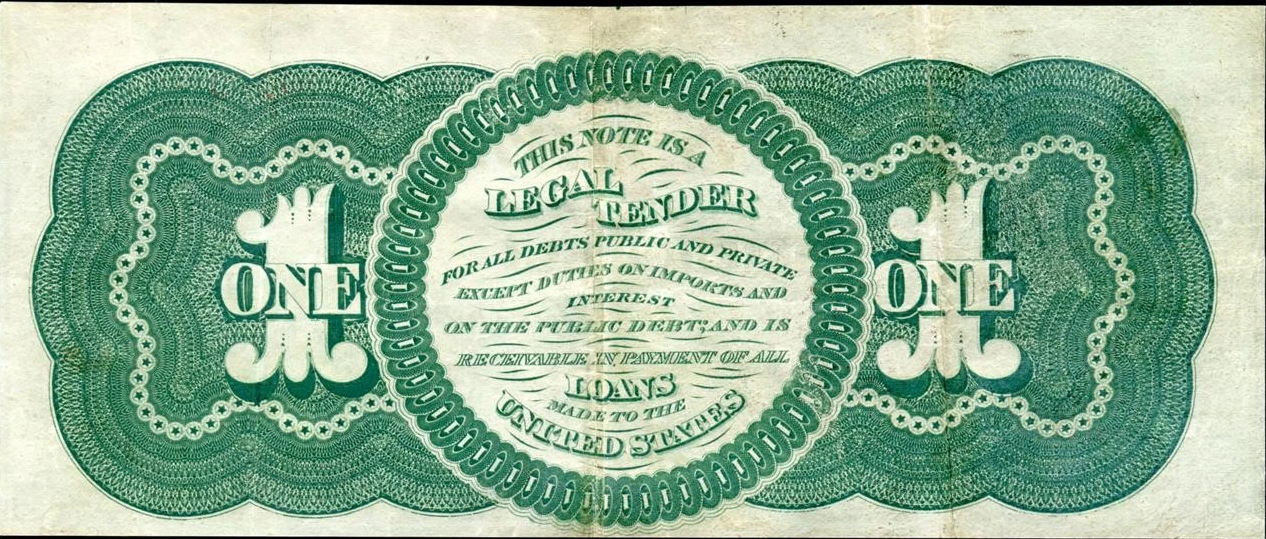
Reverse design features:
- Green ink printing: The distinctive "greenback" color that gave the series its nickname
- Ornate counters and lathework: Featuring the denomination "1" in multiple locations
- Distinctive border designs: Elaborate patterns that exemplify Civil War-era engraving
Notes from this era were printed on large sheets and hand‑cut, resulting in the distinctive oversized format that collectors prize today. The intricate designs were intended to deter counterfeiting, but they also produced some of the most visually stunning currency in American history.
Salmon P. Chase – The Man on the First $1 Note
Salmon Portland Chase (1808-1873) served as Secretary of the Treasury under President Abraham Lincoln from 1861 to 1864. He was the driving force behind the creation of the national banking system and the issuance of the first Legal Tender Notes – the "Greenbacks."
Chase's portrait on the first $1 note is fitting: he was the man responsible for the very currency he appears on. Later in his career, Chase became Chief Justice of the United States Supreme Court, presiding over the impeachment trial of President Andrew Johnson. He is one of the few Americans to have held two of the highest offices in the nation – Treasury Secretary and Chief Justice – and to have appeared on U.S. currency.
Condition – What "HIGH GRADE" Means for This Note
For the 1862 $1 Legal Tender Note, "HIGH GRADE" is a relative term that carries significant meaning. Due to the note's widespread circulation during and after the Civil War, most surviving examples grade in the Fine to Very Fine range (F-12 to VF-25). Examples grading Extremely Fine (EF-40) or better are considered condition rarities.
The note offered here is a HIGH GRADE example. Please review the photographs carefully to assess its exact condition and grade. Professional grading by PMG or PCGS is recommended to confirm the grade and maximize value.
Why This Note is Extraordinary
Historical Significance – The First $1 Note: This note represents the very first time the United States government issued a one-dollar bill. For collectors of "firsts" in American numismatics, few notes can match the importance of the 1862 $1 Legal Tender.
Birth of the "Greenback": The term "greenback" – still used today to describe U.S. paper currency – originated with this series. The green ink on the reverse of these notes was a technological innovation that gave them their distinctive appearance and their famous nickname.
Civil War Era Provenance: These notes were printed and circulated during the darkest days of the Civil War. They financed the Union war effort and helped preserve the United States. Owning one is owning a tangible piece of that pivotal moment in American history.
Condition Rarity: Most 1862 $1 Legal Tender Notes that survive today show heavy circulation. A HIGH GRADE example – especially one in AU or UNC condition – represents a tiny fraction of the already limited surviving population. According to census data, only about 20 Uncirculated examples are known to exist [citation:8].
Collector Demand – Type Note & Date Note Rarity: The 1862 $1 Legal Tender is a sought‑after "type note" for collectors building comprehensive sets of large‑size currency. It is also a prized "date note" for those specializing in Civil War era or Legal Tender series. Demand consistently outpaces supply, and high grade examples are almost never available for extended periods.
Portrait of Salmon P. Chase: The large portrait of Treasury Secretary Salmon P. Chase – the architect of the Greenback – adds historical depth. Chase's role in creating the national banking system and his later service as Chief Justice make him one of the most significant figures depicted on U.S. currency.
Investment Potential: Historic first-issue currency, especially in high grade, has shown consistent appreciation over time. The Fr. #16c is a cornerstone note that belongs in any serious collection of United States paper money.
Provenance & Census Data
According to available census data from PCGS and PMG, over 500 examples of Fr. #16c have been graded across both services combined. However, the vast majority grade in the Fine to Very Fine range. High grade examples are scarce:
- Only approximately 20 Uncirculated examples are known to exist across both grading services
- At the Gem Uncirculated level (65 and above), fewer than 5 examples have been graded
- The finest known example is a PCGS Gem New 66PPQ, realized over $10,000 at auction
This note is sold raw (uncertified) unless otherwise noted. Professional grading is recommended to confirm its place in the condition census.
This represents a significant opportunity for the type note collector, the specialist in Civil War era currency, or the discerning collector seeking a high grade example of America's first $1 note.
Authenticity Guarantee
Please review all photos carefully. The images show the exact note you will receive. This note is guaranteed genuine and original – an authentic 1862 $1 Legal Tender Note (Friedberg #16c) – the first $1 note issued by the United States government. If proven otherwise, a full refund will be provided. High‑resolution photos are considered part of the description.
Shipping & Payment
This historic note will be shipped flat and securely between rigid archival‑quality materials to ensure safe delivery. Insurance and signature confirmation are required and included in the shipping cost. International shipping is available upon request. Please contact us with any questions before purchasing.
This note is sold as shown. Serious inquiries and reasonable offers are welcome. A HIGH GRADE example of the first $1 note ever issued by the United States – the 1862 Legal Tender "Greenback" with Salmon P. Chase portrait. A true cornerstone for any advanced collection of American currency.
Share